


Cushioning Materials for Packaging: A Selection Guide from Product Weight to Shipping Mode
Choosing cushioning packaging does not start with a material name or a thickness. Before any material is specified, four conditions need to be confirmed: product weight and center of gravity, vulnerable areas, transit environment, and estimated volume. Those four determine the material, density, thickness, insert structure and converting method that follow.
A familiar situation in the field: the outer carton shows no visible damage and the cushioning looks intact, yet the unit arrives with loosened fasteners, a damaged mechanism or a failed precision component. In most cases the packaging was filling and restraining the product, but it was not reducing the shock transmitted to it during transit. Evaluating cushioning is therefore not a question of how much material went into the box, or whether the wall is thick enough. The question is whether the material compresses under load in a way that absorbs the impact energy before it reaches the product.
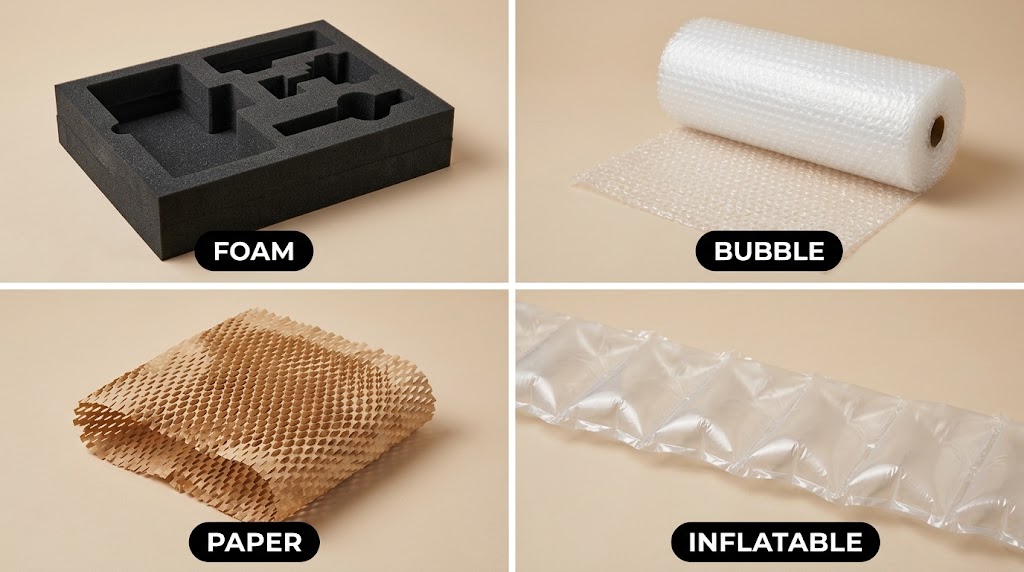
Cushioning materials fall into four broad categories: foam, bubble products, paper-based cushioning and inflatable cushioning. Each differs in how it absorbs energy, how it can be converted, how much storage it occupies and which products it suits. The sections below start with the four damage risks a product meets in distribution, then compare the materials and set out a way to select between them.
Which four transit risks does cushioning packaging address?
Products face more than drop impact in storage and distribution. Vibration, stacking load and surface abrasion often act on the same unit over the same journey. The first step in any cushioning design is identifying which of the four a given product most needs protection from.
Impact shock
Impact shock occurs during manual handling, loading and parcel sortation. When a package lands, the energy transfers through the carton and the insert into the product, so the material has to compress under load and absorb part of that energy before it reaches the item.
A material that is too rigid, too thin, or that bottoms out quickly under load may provide very little protection even when it shows no visible damage afterwards. Where a route involves repeated handling and more than one potential drop, recovery after compression becomes just as important as the first impact.
Vibration
Vibration acts on a product continuously throughout road, sea and other long-duration transport. It behaves differently from a single drop. Alongside the cushioning performance of the material, the design has to account for how the product is restrained, the natural frequency of its structural components, and whether sustained vibration will loosen fasteners, break contacts or cause fatigue damage.
A packaging design that works for domestic parcel delivery will not necessarily transfer to a long export route. Transit duration, the number of handling points and the mode of delivery all belong in the assessment.
Compression and creep
Warehouse storage and pallet stacking place a static load on the carton and the cushioning inside it for extended periods. Short-term compressive strength is only part of the picture; the material also has to be assessed for creep and permanent deformation under sustained load.
If an insert loses height after weeks under load, the product no longer sits where the design intended. That can distort the carton, shift the product or concentrate pressure on one area. For heavier items, or for anything held in storage for long periods, single-drop performance alone is not enough to judge whether a material is suitable.
Abrasion
Vibration in transit produces small, repeated movements between the product and the material touching it. For general industrial parts the effect is often minor, but painted finishes, plated components, high-gloss surfaces, mirrors and optical parts are usually sensitive to it.
For those products, the assessment extends beyond impact protection to whether the contact surface will leave scuffing, hazing or witness marks. A unit can be fully functional and still be returned over a cosmetic defect.
Four types of cushioning material, and what each one suits
Cushioning materials can be grouped by structure and protection mechanism into foam, bubble products, paper-based cushioning and inflatable cushioning. The useful question is not which category is best, but which one matches the product weight, vulnerable areas, distribution environment, positioning requirement and packaging budget in front of you.
Foam
Foam suits products that need impact cushioning, positioning, structural support or a custom insert.
Its cellular structure compresses under load, and performance can be tuned through density, thickness and insert geometry. Foam can also be cut, die cut or contour machined to the shape of the product, which concentrates support where it is needed and clears buttons, connectors and other protruding features that should not carry load.
The common materials are expanded polyethylene (EPE), ethylene vinyl acetate (EVA), polyurethane foam (PU), expanded polystyrene (EPS, commonly referred to as styrofoam) and physically or chemically cross-linked polyethylene foam (XPE/IXPE).
We produce EPE, EVA, PU and XPE/IXPE. For a closer look at how the foam grades compare on density, converting method and typical application, see our comparison of four packaging foams, or go straight to EPE, EVA, PU and XPE/IXPE.
Bubble products
Bubble products suit surface protection, wrapping and general cushioning for lightweight items.
Sealed air pockets provide the cushioning effect under load. The material is light and quick to apply, which is why it is common for electronic accessories, small components and outer wrapping. Actual protection depends on bubble diameter, number of layers, film gauge and how the product is wrapped. For heavier items, products with obvious structural weak points, or anything that needs to be held in a fixed position, a single layer of bubble material is rarely sufficient on its own and needs to be combined with additional support. Specifications are listed under bubble bags and bubble paper.
Paper-based cushioning
Honeycomb paper, kraft padding and similar paper structures are used for void fill, separation and restraint inside the carton, and they suit projects with a plastic-reduction or all-paper requirement. Protection depends on paper weight, structural form, quantity used and the direction of the load. For heavier products or long transit routes, the assessment also has to cover how well the structure holds up after compression, and how ambient humidity affects paper strength.
Whether paper suits a given product is therefore not settled by calling it a sustainable alternative. It still has to be verified against the actual packed weight and the real distribution conditions.
Inflatable cushioning
Air pillows, air column bags and similar products suit void fill, product separation and operations where storage space is tight.
Before inflation the material stores as roll stock or flat film, which keeps the footprint of the packaging material itself small, and it is inflated at the pack station when needed. That is a real advantage for higher-volume shippers working in a confined packing area. The points to check are film gauge, seal integrity, sharp corners on the product, pressure change in transit, and whether the site needs inflation equipment. For heavy items or products with sharp edges, puncture and deflation risk deserve particular attention.
Protective packaging materials compared: four types side by side
For buyers still weighing foam against bubble, paper and inflatable options, seven criteria are a practical first filter before material specifications are discussed in detail.
Quick comparison of the four cushioning material types (foam, bubble, paper-based, inflatable)
The table below sets the four categories side by side across seven criteria: primary role, recovery after compression, temperature and humidity, surface protection, converting flexibility, storage requirement and main cost drivers. Use it to shortlist a material category before moving on to grade and specification.
| Criterion | Foam (EPE / EVA / PU / EPS) | Bubble (bags / paper) | Paper-based (honeycomb / padding) | Inflatable (air pillows / column bags) |
|---|---|---|---|---|
| Primary role | Impact cushioning, positioning, support, custom inserts | Surface wrapping, scratch protection, light cushioning | Void fill, restraint, separation, structural support | Void fill, separation, light cushioning |
| Recovery after compression | Varies with grade and density; generally suited to repeated loading | Depends on bubble integrity and material specification | Limited recovery once the structure collapses | Depends on seal integrity and cell structure |
| Temperature and humidity | Closed-cell grades absorb little water; service temperature still needs confirming | Good moisture resistance; check how temperature extremes affect film and internal pressure | Performance is readily affected by humidity | Good moisture resistance; cell pressure shifts with ambient conditions |
| Surface protection | Selectable by hardness and surface finish | Suited to general surface wrapping | Abrasion risk needs checking on high-gloss and precision surfaces | Film surface suits general separation |
| Converting flexibility | High: cutting, die cutting and three-dimensional machining | Low: mostly roll stock or preformed bags | Moderate: adjustable through paper structure and packing method | Limited by existing cell sizes and formats |
| Storage requirement | Formed parts need dedicated storage space | Roll stock and finished bags both need space | Varies with supply format | Small footprint before inflation |
| Main cost drivers | Grade, density, thickness, converting method and order quantity | Film gauge, bubble diameter, layers and usage | Paper specification, structure and usage per carton | Film specification, usage and inflation equipment |
This table is useful for ruling out categories that clearly do not fit. It does not replace packaging engineering validation. Two inserts made from the same EPE can perform very differently once density, thickness, contact area and insert geometry change.
To narrow down grade, density and converting method, send us the product weight, dimensions, vulnerable areas and transit conditions, and request a cushioning recommendation.
A 4-step selection process: from product conditions to material and tooling
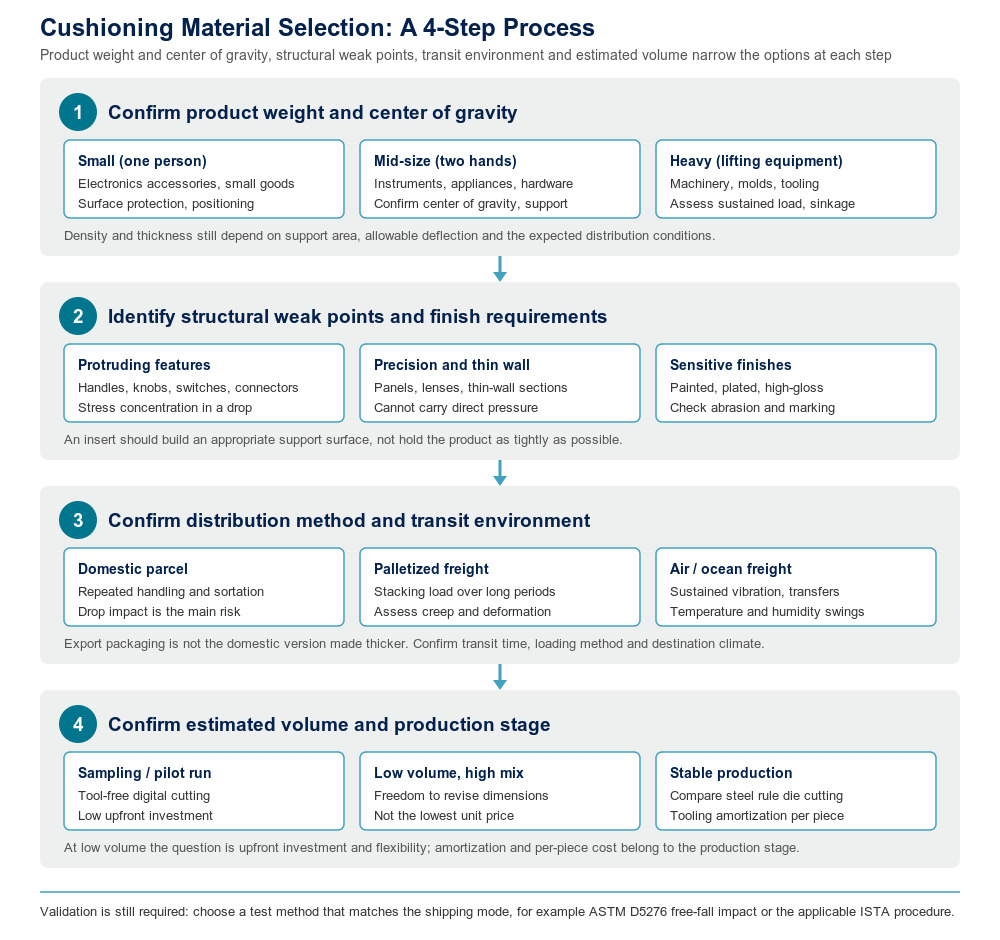
Since 1995 we have developed more than ten thousand packaging designs. In practice, working through product and distribution conditions to rule out what does not fit is faster than specifying EPE, EVA or any other material at the outset. If what you need instead is a grade-by-grade comparison of specification and cost, our comparison of four packaging foams covers that in more detail. The four steps below are a working sequence for an initial selection.
Step 1|Confirm product weight and center of gravity
Weight sets the load on the packaging and the energy released in a drop. Center of gravity determines how the package actually lands, and where the insert needs to carry support. For an initial inquiry, grouping products by how they are handled is usually enough:
-
Small products one person can lift comfortably
: electronics accessories and small consumer goods, where surface protection, positioning and general drop risk come first. -
Mid-size products that need two hands
: industrial instruments, appliances and hardware assemblies, where weight, center of gravity and the main support points all need confirming. -
Heavy products that need a forklift or lifting equipment
: large machinery, molds and tooling, where sustained load, sinkage over time and pallet securing matter alongside impact.
Density and thickness cannot be specified from these three bands alone. They still depend on product weight, support area, allowable deflection and the expected distribution conditions.
Step 2|Identify structural weak points and finish requirements
The next question is where the product cannot take load. Protruding handles, knobs, switches, connectors, precision panels, lenses and thin-wall sections all become stress concentration points in a drop or under vibration. The purpose of an insert is not to hold the product as tightly as possible. It is to build an appropriate support surface while clearing the areas that cannot carry direct pressure.
For irregular product shapes and for low-volume, high-mix parts, tool-free digital cutting or 3D contour carving can produce a custom insert that follows the profile of the product, clears the protruding features and supports it where support is actually needed.
Step 3|Confirm distribution method and transit environment
The same product carries different risks by parcel, palletized freight or export container, so the packaging specification can differ too. Domestic single-parcel delivery usually means repeated manual handling, sortation and drops. Long-haul road and ocean freight add sustained vibration, stacking and temperature and humidity swings across transit and storage.
Export packaging is therefore not a matter of thickening the domestic version. Transit duration, loading method, stacking conditions and destination climate should all be confirmed before material and structure are decided.
Step 4|Confirm estimated volume and production stage
The last step is estimated volume, because it drives the converting method and the total packaging cost. For new product development, pilot runs or low-volume, high-mix projects, tool-free digital cutting is usually the better starting point: it avoids the upfront tooling investment and keeps dimensional changes easy. Once the specification is fixed and volume stabilizes, comparing tooling cost, per-piece converting cost and throughput for production methods such as steel rule die cutting generally reflects the real purchasing decision. At low volume the question is not the lowest unit price; it is upfront investment and the freedom to revise. Tooling amortization and per-piece cost belong to the production stage.
If you are not sure whether your current volume suits digital cutting or die cutting, our project engineering team can assess the converting method against your specification and quantity.
Validation is still required after the design is finished
Selecting a material does not finish the packaging design. For high-value equipment, precision products and long export routes in particular, choose a test method that matches the product weight, distribution mode and actual risk profile.
ASTM D5276, for example, evaluates how a packaged unit performs under free-fall impact. Where a fuller simulation of the distribution environment is needed, the applicable ISTA procedure can be selected according to the real shipping mode, covering drop, vibration, compression and climatic conditions.
Any change to material, density, thickness or insert structure is worth re-validating with a small trial pack and shipment, recording damage rate, cosmetic damage and packing line efficiency rather than comparing material unit price alone.
When foam is not necessarily the right answer
Foam offers strong converting flexibility and cushioning design freedom, but not every product needs it. In the three situations below, other options are usually more efficient on cost or on space.
1. Lightweight products that only need surface protection
Apparel, some plastic consumer goods and other low-weight items with robust structures are mainly exposed to abrasion, dust and general handling contact. Bubble material, paper or another simple wrap is worth assessing first. Adding a foam insert will not necessarily reduce risk in proportion to its cost.
2. Filling void space inside the carton
Where the product already has its own packaging or restraint and the only requirement is to stop it moving, air pillows and paper padding are usually easier to apply, and they avoid the storage space a preformed insert occupies. If the product needs load bearing, positioning or drop-impact control, though, void fill and cushioning protection are not the same job.
3. Projects with a defined plastic-free or material restriction
Where brand policy, a customer purchasing condition or the destination market explicitly requires plastic-free packaging, the design has to move to a compliant paper or alternative material from the outset. These projects are not settled by whether a single material is recyclable. They depend on the customer's material policy, the certification required and the recycling infrastructure actually in place locally.
Sustainable cushioning: separate recyclable material from available recycling route
Two questions need separating in any discussion of sustainable cushioning: whether the material can be reprocessed, and whether a workable collection route exists where it is used. EPE is based on polyethylene, and clean, single-material industrial offcuts can be reclaimed and reprocessed through the appropriate channels. Foam is bulky and light, though, so what actually happens to it depends on collection cost, contamination level and the local recycling system.
For B2B users the practical approach is to confirm first whether process offcuts and post-use packaging can be segregated and kept clean, then check collection terms with a licensed local recycler or reprocessor.
Paper-based cushioning has an advantage in single-material streams, but where a product faces high humidity, long transit or higher loads, packaging performance has to be validated alongside it. Sustainable material selection still has to balance material reduction, product protection, transport efficiency and end-of-life handling, rather than comparing material names.
Frequently asked questions
Q1: What types of cushioning material are there?
Cushioning materials fall into four categories: foam, bubble products, paper-based cushioning and inflatable cushioning. The right choice depends on product weight, vulnerable areas, positioning requirements, distribution method and packing line conditions, not on material unit price alone.
Q2: When are bubble bags enough, and when is a foam insert needed?
For lower-weight products where the requirement is surface scratch protection, separation or general handling protection, bubble products are usually worth assessing. For heavier products, products with protruding or fragile features, products that need to be held in position, or routes with high drop risk and sustained vibration, a foam insert or another structural cushioning solution should be evaluated instead.
Q3: What alternatives are there for companies reducing bubble wrap and plastic packaging?
Where the requirement is void fill and restraint, honeycomb paper and kraft padding are worth assessing. Where the bubble material was also carrying a cushioning function, it cannot be swapped for the same volume of paper. For precision or heavier products, re-run the packaging tests to confirm the replacement still protects under drop, vibration and compression.
Q4: Should packaging design prioritize preventing damage or avoiding over-packaging?
Both belong in the total cost assessment. Insufficient protection adds damage, returns, repair, reshipment and complaint-handling costs. Over-packaging adds material cost, packing labor, storage space and dimensional weight charges. The goal is not more thickness; it is the material, thickness and structure that passes validation against the distribution risk you actually face.
Q5: Does a custom protective insert always require tooling?
No. During development, sampling and low-volume, high-mix stages, tool-free methods such as digital cutting keep the upfront investment low and leave room to revise. Once dimensions and packaging structure are settled and demand is stable, compare the cost and throughput of production methods such as steel rule die cutting.
Q6: How long does sampling take?
Sampling normally takes 5 to 10 working days. If drop testing or other packaging validation follows, schedule the sample and the test together when the structural drawing is confirmed, and leave time for a specification revision afterwards.
Q7: How should foam offcuts from the factory be handled?
Clean, single-material EPE process offcuts that are free of oil, adhesive and other contamination can be segregated and collected, then taken to a licensed local recycler or reprocessor to confirm collection and reuse terms. Because foam is bulky and light, what is practical depends on the region and on each recycler's acceptance criteria. For B2B manufacturers, in-house segregation followed by collection through a recycling partner is usually the workable route.
Get a cushioning recommendation for your product
This guide will help you narrow down the direction. The material, density, thickness and insert structure still have to be confirmed against the product itself and its distribution conditions. When you send an inquiry, four details let our engineering team go further:
-
Product weight and outer dimensions
: note it if the center of gravity sits clearly to one side. -
Main vulnerable areas
: corners, display panels, lenses, protruding handles, connectors or any area that cannot take direct pressure. -
Primary distribution method
: domestic parcel, palletized freight, air freight or long-haul ocean freight. -
Estimated volume and project stage
: new product sampling, pilot run or stable production.
The more complete the information, the further our engineers can go on material, thickness, support method and converting process, instead of treating added thickness as the answer to a damage problem.
If you already use our materials and only need a dimensional change, a specification adjustment or a repeat of an existing item, include the current part number or drawing reference with your inquiry and we can confirm against the existing specification quickly.


